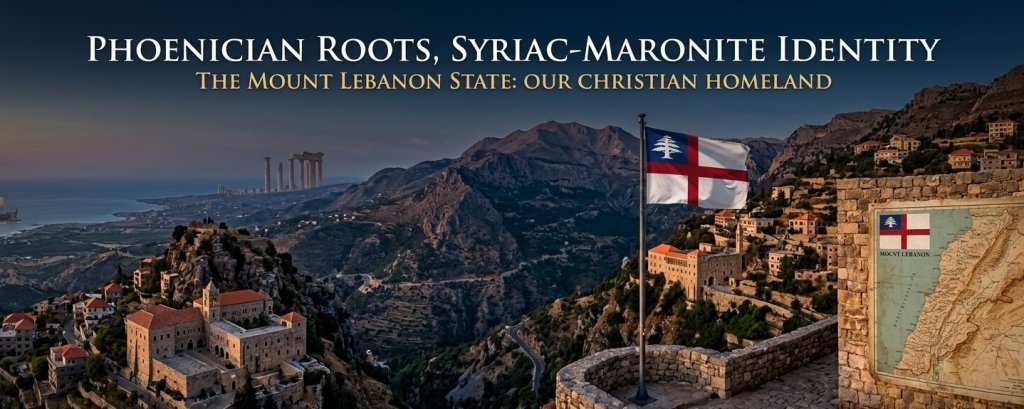
Introduction: The Collapse of a Century-Old Lie
For over a century, the Christians of Mount Lebanon have been told to believe in a myth. We were told that a state stretching from Tripoli to Tyre, and from the Mediterranean coast to the plains of the Beqaa, could serve as a secure home for its indigenous people while existing as a “message of coexistence.” Today, as we look at the ruins of the Lebanese Republic, a failed state plagued by economic collapse, institutional paralysis, iranian occupation, and a critical demographic erosion of the Christian population, the harsh reality can no longer be hidden. Greater Lebanon, as conceived in 1920, was not a victory; it was a demographic and political trap.
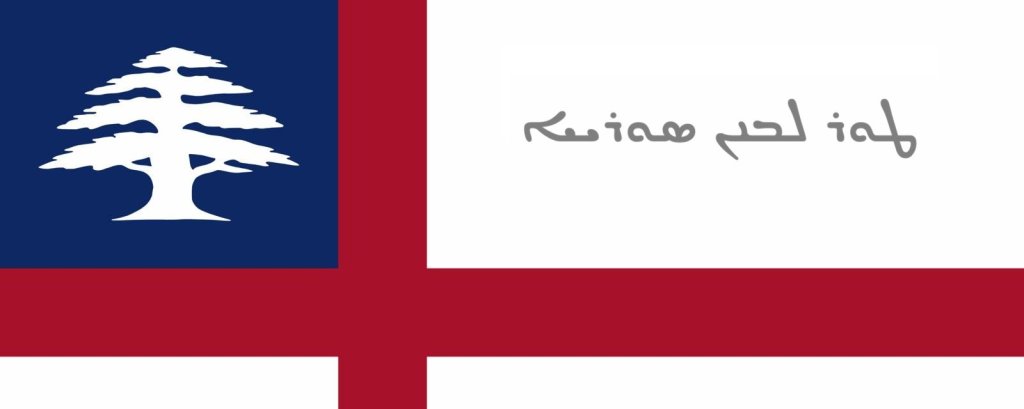
We in the Mount Lebanon Project advocate for an uncompromised, definitive solution: separation from the Lebanese Republic and the realization of our right to self-determination. We demand a sovereign Christian homeland where we rule ourselves by ourselves. We are done sacrificing our security, our cultural identity, and our children’s future on the altar of an imaginary, forced partnership.
Yet, as this call for survival gains momentum, certain romanticizing voices seek to derail our path to statehood. These are the modern-day “Phoenicianists”; individuals who insist on reviving a multi-communitarian Levant based on an ancient merchant model that died over two millennia ago. They preach a utopian project of an inclusive “Phoenician Lebanon” where all sects magically unite under a shared maritime heritage.
Let us be completely clear: those who still preach the “Phoenician coexistence” model are suffering from a dangerous political blindness. They fail to see what the other side actually wants, and they refuse to accept that the ideological landscape of the Levant changed permanently fourteen centuries ago. This article will deconstruct this dangerous nostalgia, ground our true identity in its authentic Syriac-Maronite roots, and demonstrate why a sovereign Mount Lebanon State is the only path left to prevent our total eradication.
Part I: The Fallacy of the Phoenician Coexistence Project
The core mistake of the modern Phoenician advocates is anachronism, projecting ancient realities onto a completely different modern world. They point to the ancient coastal city-states like Byblos, Sidon, and Tyre, arguing that because these independent hubs functioned as decentralized, multicultural trade centers 2,500 years ago, a similar open-border, multi-sectarian model can work today.
This argument ignores basic historical chronology. As historians have noted, ancient Phoenicia was never a unified nation-state; it was a collection of distinct mercantile ports. More importantly, that economic and cultural model died out more than 2,200 years ago. By the Hellenistic and Roman periods, the old Phoenician language and socio-political systems had faded entirely, structurally replaced by the Aramean culture and the Aramaic language, which became the lingua franca of the entire Near East.
To suggest that a 21st-century state can be stabilized by invoking a long-dead Bronze Age trade alliance is worse than naïve, it is politically reckless. Ancient Phoenicia operated in a world of pagan empires and commercial treaties, long before the rise of absolute theological systems that demand total social and political dominance. You cannot run a modern state facing systemic existential threats using the logic of an ancient maritime trade market.
Those who try to revive this model are completely blind to the demographic and ideological realities on the ground. They are attempting to build an identity for a nation that does not want it.
Part II: The Monolith of Arab-Islamic Identity
The ultimate failure of the “Phoenician Lebanon” project lies in a simple, undeniable truth: no one accepts this identity except Christians and a microscopic minority of secular Muslims who represent no one but themselves.
The vast majority of the non-Christian population in the Lebanese Republic rejects the Phoenician label outright. They identify openly, proudly, and purely as Arabs. Their cultural, political, and historical allegiances lie with the broader Arab and Islamic world, not with a pre-Christian maritime civilization. By trying to force a “Phoenician” identity onto communities that explicitly view themselves as part of the Arab Ummah (nation), Phoenician idealists are talking to themselves in an empty room.
Furthermore, we must address the structural nature of the dominant ideology surrounding us. Politically and sociologically speaking, classical Islamic expansion brought with it a system where the primary, overriding identity is religious and political adherence to Islam. In this framework, localized, historical, or national identities are absorbed into the grander Islamic framework.
Historical and political analysts of the Levant, such as Antoine Fattal in his seminal work on the legal status of non-Muslims under Islamic law, have documented how the traditional political systems of the region classify populations strictly by religious allegiance, where non-Muslims are structurally relegated to minority status (Dhimmi). Within this framework, regional heritages, whether Phoenician, Aramean, or broader Canaanite, are viewed as irrelevant pre-Islamic remnants (Jahiliyyah).
Therefore, hoping that our neighbors will drop their deeply held Arab-Islamic identity to join us in a secular, Phoenician-inspired playground is total foolishness. They know exactly what they want: a state that reflects their demographic weight and ideological convictions. It is only the fragmented Christian leadership that remains blind to this, refusing to see that you cannot bargain for a secular contract with partners who view the state through a theological lens.
Part III: The Authentic Root: Who We Truly Are
If the Phoenician project is a dead end, what is the true foundation of our people? Our historical, linguistic, and existential identity is fundamentally Syriac-Maronite. While our ancestral genetics and roots undoubtedly carry the deep physical lineage of the ancient coastal populations (the Phoenicians), our cultural, spiritual, and political identity was forged in the furnace of the Syriac-Aramean Christian experience.
When the Maronite church was established, its liturgy, its language, and its world-view were written in Edessan Aramaic (Syriac). It was this Syriac identity that allowed our ancestors to resist assimilation during successive waves of conquests. Driven out of the fertile plains of the Orontes River, the Maronites retreated into the rugged, defensive topography of Mount Lebanon and Maronized the local population.
In the sacred geography of the Qadisha Valley and Mount Lebanon, our ancestors built a distinct, self-governing society. As the historian René Ristelhueber points out in his studies on the history of the Christian peoples of the Levant, the Maronites historically enjoyed a de facto independence, operating under their own customary laws, led by their Patriarchs and local feudal leaders, completely isolated from the administrative laws of the surrounding empires.
Our roots are tied to this soil through a legacy of survival, language, and independent spiritual authority:
- Linguistic Continuity: The spoken Lebanese dialect today remains heavily structured by Syriac grammar and vocabulary, a living fossil of our true cultural lineage.
- Ecclesiastical Independence: The Maronite Church historically acted not just as a religious institution, but as a national body representing a sovereign-minded population.
- The Mountain Fortress: Mount Lebanon was never meant to be an open plain of administrative compromise; it was chosen specifically as an inaccessible sanctuary to protect our unique lifestyle from external homogenization.
This is the identity that kept us alive for a thousand years. It was not a commercial compromise made in a coastal port; it was a fiercely defended independence in the high mountains.
Part IV: The Necessity of the Mount Lebanon State
Because the dominant regional ideologies leave no room for cultural variance, the preservation of our identity cannot be achieved through constitutional gymnastics or fragile power-sharing agreements. The Taif Agreement of 1989 and the subsequent decades of political gridlock have proven that “coexistence democracy” in a fractured state is merely a slow-motion surrender.
When a political entity suffers from irreconcilable differences regarding its identity, foreign policy, and existential values, the only logical, peaceful, and professional solution is partition. History shows us that forced multi-ethnic or multi-religious states built on artificial borders eventually implode. The breakups of Yugoslavia and Czechoslovakia demonstrate that when coexistence fails, self-determination is the only way to avoid endless civil warfare.
The Contrast: Why the Current Model Fails and the Mount Lebanon State Succeeds
The structural collapse of the Lebanese Republic stems from fundamental flaws that can only be corrected through a sovereign Mount Lebanon State. When we look at the core pillars of governance, the choice becomes clear:
- The Ideological Basis: We must move away from the artificial “Phoenician-Arab” compromise that has structurally paralyzed our identity. The proposed Mount Lebanon State embraces our authentic Syriac-Maronite heritage and right to self-determination, while maintaining a historic pride in our ancient Phoenician roots.
- Governance: The current republic is defined by systemic paralysis caused by sectarian vetoes. A sovereign Christian homeland will replace this dysfunction with a clear, homogeneous rule of law.
- Security: Today, the Lebanese state is hijacked by armed regional militias. The Mount Lebanon State will establish a total state monopoly over all defense and arms—ensuring actual peace and safety.
- Demographics: Under the 1920 model, Eastern Christians face steady decline and political marginalization. Our proposed state creates a stable, protected homeland to ensure our long-term survival.
The proposed Mount Lebanon State is not an act of aggression; it is an act of ultimate self-defense. It is a re-establishment of our historic refuge, updated for the modern era. Within these secure borders, we will have:
- Complete Legislative Autonomy: A judicial and political system free from foreign vetos and extremist pressure, allowing us to pass laws that protect our values and economic freedom.
- Cultural and Linguistic Revival: The formal re-introduction and preservation of our Syriac heritage, language, and historical narrative in our educational curriculum.
- Economic and Physical Security: Direct control over our borders, airports, resources, and security apparatus, ensuring that the wealth generated by our people is used to build our infrastructure, rather than funding a corrupt, failed capital.
Conclusion: A Clear Choice Between Autonomy and Extinction
To those who still cling to the illusion of Greater Lebanon and the Phoenician model, we say: look around you. The institutions have collapsed, the central bank is depleted, and our youth are emigrating by the hundreds of thousands. The model you are trying to save is already dead. Your insistence on an inclusive “Phoenician project” with partners who openly identify as Arabs and seek total political hegemony is an intellectual crime. You are sacrificing the living flesh of our community for the sake of an ancient, irrelevant slogan.
The Mount Lebanon Project does not look backward to a dead mercantile era. We look forward to a sovereign, modern, and secure homeland. We call upon every Christian who refuses to be a second-class citizen in their own ancestral land to drop these useless myths of forced coexistence.
Our identity is clear, our roots are deep, and our historical right to self-determination is absolute. It is time to draw our borders, end the failed experiment of 1920, and rule ourselves by ourselves. The Mount Lebanon State is no longer just a political option! it is our absolute prerequisite for survival.



Leave a Reply