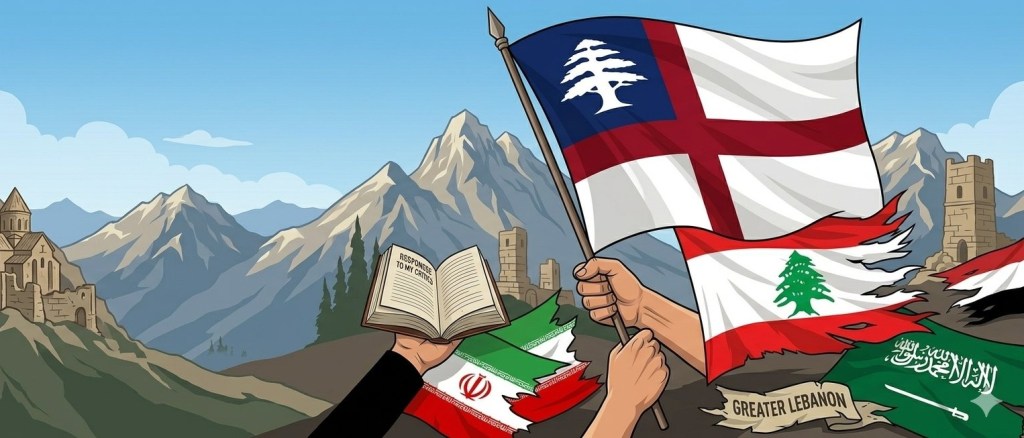
Introduction
Every time the idea of the independence of Mount Lebanon, or the right of the Syriac Maronites and other Christians to govern themselves, is raised, the same traditional narrative immediately appears:
- Partition means civil war.
- Lebanon cannot survive without all its components together.
- Mount Lebanon would not survive economically.
- Federalism or decentralization are the only possible solutions.
- Christians must accept the current reality, whatever the cost.
But this narrative ignores a fundamental question: If the current Lebanese model has completely failed politically, economically, and in terms of sovereignty, why does merely thinking about radical solutions become taboo? And are Christians in Lebanon expected to remain prisoners of a collapsed state simply out of fear of being accused of “partition”?
This article does not discuss federalism or decentralization, because the Mount Lebanon project is not fundamentally based on those concepts. Rather, it discusses a clearer and more explicit idea:
The right of an authentic historic people to restore its political sovereignty over its historic land.
First: The Mount Lebanon Project Is Not a New Idea
There is a constant attempt to portray any discussion of the independence of Mount Lebanon as either an extremist project or a modern political fantasy.
In reality, the historical facts are entirely different.
Mount Lebanon enjoyed political and administrative particularity before the creation of Greater Lebanon in 1920.
- The establishment of the Lebanese entity with Saint John Maron.
- The Lebanese Emirate.
- The The Double Qaimmaqamate
- The Mutasarrifate.
All of these models preceded the current Lebanese Republic.
In fact, Greater Lebanon itself was not unanimously demanded by Christians at the time (also rejected by mislims), because many feared the incorporation of regions with different demographic and political balances into historic Mount Lebanon.
Therefore, the project of Mount Lebanon’s independence is not the partition of a natural and stable entity, but rather an attempt to return to a historic entity that predates the current state itself.
Second: The Maronites Are Not Merely a Sect
One of the greatest errors of modern Lebanese discourse is reducing the Maronites to merely a “sect.”
The Maronite presence in Mount Lebanon is not simply a transient religious existence, but a deeply rooted national, historical, and cultural presence extending over centuries.
The Maronites as a nation:
- Preserved the free Christian presence in the Levant.
- Established the historic mountain entity.
- Developed education, culture, and journalism.
- Built the modern idea of Lebanon.
- Formed the backbone of the Lebanese entity at its founding in 685AD.
From this perspective, supporters of the Mount Lebanon project believe that the Syriac Maronites represent an authentic historic people in this land, not merely a religious minority within a centralized Arab state.
And if the world recognizes the right of indigenous and historic peoples to self-determination, why does this right become unacceptable only when demanded by the Christians of Mount Lebanon?
Third: Is Partition the Cause of the Crisis… or a Result of It?
The discourse rejecting partition treats the idea as though it would cause Lebanon’s collapse.
Reality says the exact opposite.
The idea of separation did not emerge because Christians seek war, but because the current Lebanese state has reached a stage of near-total collapse:
- Economic collapse.
- Loss of sovereignty.
- Multiple armed forces.
- Institutional paralysis.
- Currency collapse.
- Mass emigration.
- Loss of national trust.
The real question, therefore, is not: Why are some people speaking about separation?
But rather: How can a state continue when it is no longer capable of functioning as a state in the first place?
Fourth: Responding to the Claim That Partition Would Inevitably Lead to War
The Lebanese Civil War is constantly used as a scarecrow to prevent any radical political discussion. But the truth is that Lebanon is already living a form of internal cold war:
- Politically closed regions.
- Undeclared security borders.
- Weapons outside the authority of the state.
- Deep strategic contradictions between the components of the country.
In other words, the current unity is not genuine unity, but a fragile coexistence imposed by force and balances of power. Moreover, world history does not say that every separation necessarily leads to war.
There have been peaceful separations when forced coexistence became impossible:
- Czechoslovakia.
- The Baltic states.
- The dissolution of the Soviet Union.
The problem is not the principle of separation itself, but the way it is managed.
Fifth: What About the Bekaa? Can Mount Lebanon Survive Without It?
This is one of the most repeated arguments in any discussion about the independence of Mount Lebanon. It is often presented as though Mount Lebanon is an economically incapable entity that cannot survive without the Bekaa. But this argument ignores several fundamental realities.
1. Historically, Mount Lebanon Was Not Built Solely on Agriculture
Throughout history, the primary strength of Mount Lebanon was:
- Trade.
- Ports.
- Education.
- Banking.
- Services.
- The diaspora.
- Investment.
Its economy was always primarily maritime, commercial, and service-oriented, rather than a traditional agricultural economy.
2. Many Countries Survive With Fewer Resources
There are very small states that succeeded economically despite limited territory and natural resources:
- Singapore.
- Luxembourg.
- Malta.
- The UAE before oil.
What matters is not merely the amount of agricultural land, but the nature of the economic system, governance, sovereignty, and stability.
3. Economic Interdependence Does Not Necessarily Require Political Unity
Even if economic integration exists between Mount Lebanon and the Bekaa or other regions, this does not necessarily require remaining within a single centralized state. The world is full of independent states that exchange:
- Water.
- Electricity.
- Food.
- Trade.
Through normal agreements between states. Therefore, economic relations do not negate the political right to self-determination.
Sixth: Do Christians Want to Expel Others?
One of the most common distortions is portraying the Mount Lebanon project as a project of exclusion or ethnic cleansing. But the core idea of the project is:
- The governance of historic Christians over their historic land.
- Within a state with a clear identity.
- With full respect for the civil and individual rights of all residents.
In other words, the project is not based on religious or racial elimination, but on ending the condition of political and demographic dilution experienced by Christians within the current system.
No human community in the world willingly accepts gradual transformation into a powerless minority within land it considers its historic homeland.
Seventh: Illegal Weapons Changed the Meaning of Lebanon
It is impossible to ignore the central issue that is constantly avoided. Lebanon is no longer truly a unified sovereign state. The existence of an armed force independent from the state and linked to a regional axis has fundamentally altered the nature of the Lebanese entity.
For many Christians, the crisis is no longer merely economic or constitutional, but existential. Because the question has become:
Can Christians continue within a state in which they do not possess the final sovereign decision? And can a pluralistic state survive when decisions of war and peace lie outside its official institutions?
From this perspective, we see the Mount Lebanon project not as isolationism, but as a project for the protection of a threatened political and civilizational existence.
Eighth: Why Are Federalism or Decentralization Not Enough?
Many attempt to present federalism or expanded decentralization as a compromise solution. But supporters of the Mount Lebanon project believe these proposals are no longer sufficient for several reasons:
- Because ultimate sovereignty would still remain in the hands of the central state.
- Because the decision of war and peace would remain unchanged.
- Because the broader demographic balance would continue shifting.
- Because the Lebanese experience has proven that any constitutional balance can be overridden through political or military force.
Therefore, supporters of the project believe the real solution must be clear and explicit:
An independent entity possessing full political and sovereign authority over its own affairs.
Ninth: Is the Project Realistic?
Claiming that the Mount Lebanon project is unrealistic ignores the fact that most major political transformations in history appeared impossible before they happened.
- The collapse of the Soviet Union.
- The breakup of Yugoslavia.
- The independence of East Timor.
- The independence of South Sudan.
- The independence of Somaliland.
All of these once seemed unrealistic. Politics changes when the old formula becomes no longer viable. And this is precisely what many Lebanese Christians feel today.
Conclusion The debate surrounding the Mount Lebanon project is not an emotional or isolationist discussion, as some attempt to portray it. Rather, it is a discussion tied to deep existential, sovereign, and historical questions:
- Who governs?
- Who decides war and peace?
- Is the current Lebanese model still viable?
- And does a historic people have the right to govern itself on its historic land?
Blind attachment to a formula that has demonstrably failed is not patriotism. Likewise, rejecting any discussion about self-determination through moral intimidation or accusations of treason is no longer sufficient to convince anyone.
And in the end, one fundamental truth remains: A genuine partnership cannot be built within a state when an essential part of its people feels that its political and historical existence is under threat.
For this reason, the Mount Lebanon project is no longer merely an idea for many people, but has become a project of political and civilizational survival. Any Christian concerned with the continuity of his people should stand beside these Mount Lebanese voices and help refine the tactics rather than undermine the strategy itself.



Leave a Reply