Introduction
This paper investigates the multifaceted ways in which the unique geographic features of Mount Lebanon have historically fostered and sustained a distinct Maronite national identity, positioning it as a cohesive nation rather than merely a religious sect (Çöp, 2019).
The mountainous terrain provided a natural barrier, facilitating the emergence of a unique Lebanese reality and a degree of political independence from ancient times (Élias, 2013).
Maronites and the Mountain
The formidable topography of Mount Lebanon, characterized by its challenging natural conditions, cultivated a resilient population and distinct ways of life among its inhabitants (Chidiac, 2015). This unique geography, encompassing both mountainous defenses and a maritime façade, established Mount Lebanon as a natural refuge for various persecuted groups, notably the Maronites and Druze, who established distinct social and religious communities there as early as the 10th century (El-Chami, 2017; Fernández, 2023).
This rugged landscape not only offered sanctuary but also necessitated a strong sense of communal solidarity and self-reliance, contributing to the development of a proto-national consciousness centered on the preservation of their distinct cultural and religious heritage (Élias, 2013).
This isolation, while fostering internal cohesion, also shaped their interactions with external powers, often leading to strategic alliances and negotiations for autonomy rather than outright conquest.
The Maronite Church, central to Maronite identity, played a pivotal role in this process, actively shaping their socio-cultural and socio-ecclesiastical dynamics within this geographically defined haven (Mzawak et al., 2025).
Its extensive history and distinctive religious identity, despite residing in the Middle East, have positioned the Maronite Church as a significant entity within the Lebanese religious and social landscape, warranting exploration from a socio-ecclesial perspective (Mzawak et al., 2025).
Furthermore, the interplay between their religious identity and the geographical sanctuary afforded by Mount Lebanon contributed significantly to the Maronites’ perception of themselves as a distinct national entity, separate from broader regional identities (Fernandez, 2009; Mzawak et al., 2025).
This perspective challenges the traditional understanding of the Maronites merely as a religious group by highlighting their deep-rooted historical and geographical connections to Mount Lebanon, which fostered a unique sense of collective belonging and self-governance (Baladi, 2018).
Borders
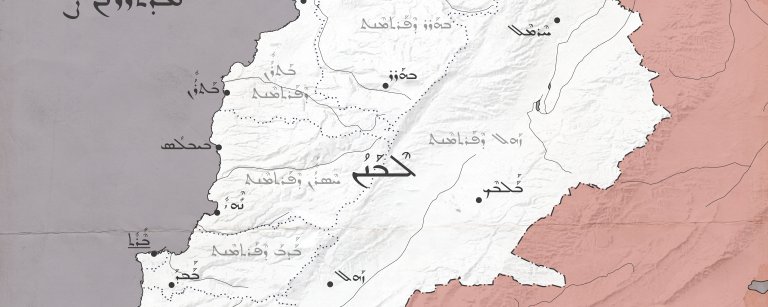
The territorial definition of Mount Lebanon acquired particular institutional clarity during the Mount Lebanon Mutasarrifate (1861–1918), an autonomous Ottoman administrative unit designed to stabilize communal relations in the mountain following sectarian violence. Although its borders were deliberately restricted, excluding the Beqaa Valley and major coastal cities such as Beirut, Tripoli, Sidon, and Tyre; the Mutasarrifate established a territorially coherent mountain core extending across the central Mount Lebanon range and its western slopes. These boundaries, while politically constrained and economically limiting, remained largely stable.
The creation of Greater Lebanon in 1920 incorporated previously excluded regions into the modern Lebanese state, but did not dissolve the historical-geographical coherence of Mount Lebanon as a distinct socio-cultural space.
Up to the present day (2026), Mount Lebanon remain clearly demarcated and socially recognizable as the historical heartland of Maronite and Druze communal life. Despite the expansion of Lebanon’s borders and the integration of diverse regions and Arabs into the state, Mount Lebanon continues to function as a visible and enduring territorial core, anchoring communal memory, patterns of settlement, and political identity.
In this sense, while sovereignty, administration, and national borders have shifted, the spatial continuity of Mount Lebanon as the Maronite–Druze heartland has persisted from the Mutasarrifate period to the contemporary Lebanese state. The Mutasarrifate was largely confined to the Mount Lebanon mountain range and its immediate western slopes.
- West: The boundary generally followed the Mediterranean Sea, but it was interrupted by major coastal cities that were excluded from its jurisdiction.
- East: The border was defined by the eastern slopes of the Mount Lebanon range, stopping before the Beqaa Valley “Vilayet Syria”.
- South: It bordered the Vilayet of Beirut, excluding the cities of Sidon and Tyre, as well as the Jabal Amel and Marjayoun regions
- North: It was bordered by the Vilayet of Beirut, specifically excluding the Akkar region and the city of Tripoli.
These borders, while restrictive, remained relatively stable throughout the Mutasarrifate’s existence until 1920, when the French Mandate established Greater Lebanon, incorporating these excluded territories into the modern Lebanese state.
This stability in the heartland of Mount Lebanon has been crucial in maintaining the cultural and historical identity of the Maronite community.
Conclusion
Historical experience suggests that political entities grounded in a clearly defined coherent identity, and a shared value system are more likely to achieve internal stability, institutional continuity, and economic vitality. Such stability tends to generate a cumulative effect: effective governance fosters security and prosperity, which in turn enhances legitimacy and public trust. Over time, this dynamic can transform a stable polity into an economic and administrative hub capable of exerting attractive power beyond its original borders.
In this context, the historical core of Mount Lebanon; despite its relatively limited surface area of approximately 4,500 square kilometers, demonstrates the structural characteristics of a viable political nucleus. Its long-standing traditions of value-based governance provide a foundational model upon which broader political integration could theoretically emerge.
Expansion, in such a framework, would not be driven by coercion or territorial ambition, but by voluntary political alignment, potentially expressed through democratic mechanisms such as referendums, motivated by the demonstrated benefits of stability, equality before the law, and accountable governance.
Consequently, Mount Lebanon should be understood not merely as a historical or cultural remnant, but as a potential starting point for a scalable political model. Anchored in principles of historical values associated with its Christian-led institutional experience, such a model could offer a credible basis for gradual political consolidation. In this sense, territorial limitation does not represent weakness; rather, it may constitute the necessary condition for the emergence of a stable core capable, over time, of attracting broader participation and integration within a larger political framework.




 Turod Levnon
Leave a comment