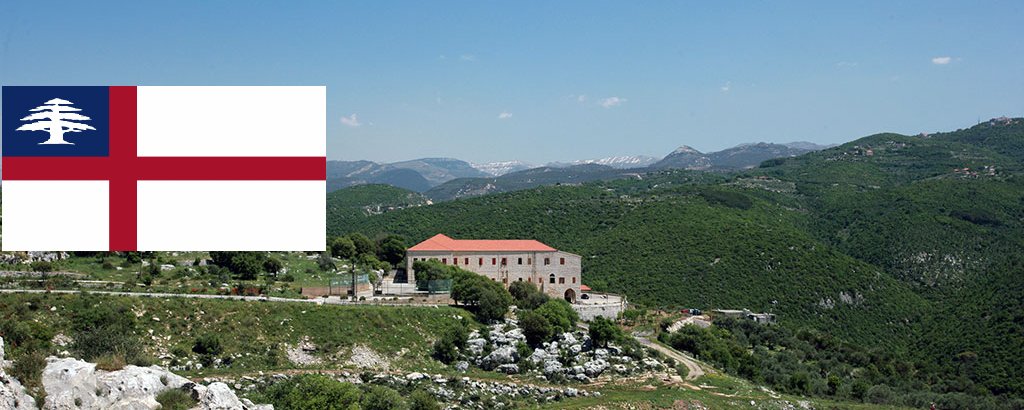
Introduction: More Than a Saint – the Founder of a Nation
On March 2, the Maronite Church commemorates Saint John Maron, the first patriarch and the visionary leader who transformed Maronitism from a “monastic condition” in the deserts of Syria into a “national identity” rooted in the mountains of Lebanon. For us the Mount-Lebanese, on March 2, we commemorate the creation of the first Lebanese State.
The story of John Maron is not merely the biography of a monk who rose to ecclesiastical leadership; it is the story of a people who, under his guidance, chose to exercise their natural right to self-determination. John Maron laid the cornerstone of what we now call “Lebanese particularity,” believing that religious freedom cannot endure without a political and geographical entity that protects it.
Origins and Formation: From Learning to Asceticism
John was born in the village of Sarum near Antioch in the 7th century (around 627 AD). He grew up in a devout aristocratic family; his father was Agathon and his mother Anohamia. Distinguished by sharp intelligence from an early age, he studied in the schools of Antioch and later in Constantinople, the imperial capital at the time, acquiring broad theological and political culture. After his father’s death, John chose the path of asceticism and went to the Monastery of Saint Maron on the banks of the Orontes River. There, he did not limit himself to prayer but devoted himself to defending orthodox Catholic doctrine, demonstrating in his theological writings that Christ has two complete natures and two complete wills. This intellectual clarity was the first weapon in the battle for spiritual independence; before Lebanon had geographical borders, it had “doctrinal borders” drawn by John Maron to distinguish his people from the intellectual subjugation of surrounding powers.
Episcopal Ordination and the Spark of the Lebanese Entity
In 676 AD, John was ordained bishop of Batroun and Mount Lebanon. This moment marked the effective declaration of the birth of the “first Maronite state.” The mountain, with its towering cliffs, was no longer merely a place of refuge but became a project for a “Christian state in Mount Lebanon.” Once appointed bishop, John began organizing Lebanese society on institutional foundations. He was not merely a church shepherd but a leader around whom the mountain chiefs and fighters rallied. He understood that Christians in the East needed a “land of refuge” (Terre-Asile). From this vision emerged the early features of separation from the Byzantine Empire, which sought to forcibly integrate the Maronites into its political and religious mold. John Maron was consciously applying, in an early form, the principle of “positive neutrality” and rejecting subservience, making Mount Lebanon an entity resistant to forced integration.
The Patriarchate: A Declaration of Sovereign Independence
In the second half of the 7th century (around 685 AD), with the See of Antioch vacant and political pressures intensifying, the notables and leaders of Mount Lebanon gathered and elected John Maron patriarch. This act was revolutionary by all standards: the Maronites broke with the tradition of waiting for imperial appointment and took the initiative to elect their own head. This election was effectively a declaration of political and ecclesiastical independence. Thus, John Maron became the first Maronite Patriarch of Antioch and the sixty-third successor of Saint Peter. According to tradition, he traveled to Rome and received the blessing of Pope Sergius, granting international legitimacy to the emerging entity. John Maron sought to proclaim to the world that the people of Mount Lebanon possessed the will to self-determination and were not an appendage of any Islamic caliphate or foreign Christian empire.
The Exodus to Kfarhay: Building the “New Jerusalem” in Batroun
Because of violent persecutions launched by Byzantine forces (which viewed Maronite independence as rebellion) and Islamic armies, the patriarch and his disciples were forced into a final migration deep into Mount Lebanon. They settled in Kfarhay, in Batroun region, where he built the monastery of Rish Moran (Ra’s Maron – “Head of Maron”). Here, the patriarchate became a form of “temporal national leadership.” In Kfarhay, not only was the relic of Maron placed, but the foundations of Lebanese self-administration were laid. The patriarch managed people’s affairs, built churches, and cared for the poor and sick, especially during the plague of 685 AD. The monastery became a rudimentary “state palace,” from which decisions affecting the security of the mountain and the lives of its inhabitants were issued; an early model of a “Lebanese State,” based on social solidarity and freedom.
John Maron as Military Leader: Defending the “Lebanese Christian Homeland”
The history of John Maron cannot be read apart from his military and political role. Historians describe him as the “first leader of the Lebanese Christian homeland project.” During his era, the Maronites achieved decisive victories against armies that attempted to invade their stronghold. John Maron was the first to advocate Lebanon’s neutrality between the two giants: the Umayyad Caliphate and the Byzantine Empire. He understood that the survival of Christians in the East depended on their ability to position themselves as an independent force that aligns with neither side against the other, but rather with the freedom of its own people. This Maronite trait of refusing defeat is what allowed the community to preserve its distinct identity throughout history, thanks to the spiritual and militant ethos instilled by their first patriarch.
Cultural and National Legacy: The School of Kfarhay and the Continuity of the Entity
John Maron’s role did not end with his death on February 9, 707 AD (commemorated on March 2). His legacy continued through the Monastery of Saint John Maron in Kfarhay, which became, in the 19th century, a school and seminary that produced major patriarchs and leaders, such as Elias Howayek (the “Father of Greater Lebanon”) and Antoun Arida. The transfer of the patriarchal seat from Kfarhay to Yanouh, then Ehlij, Qannoubine, and finally Bkerké, is in fact the transmission of the torch of self-determination. Every patriarch who sat on the throne of John Maron understood that he was not merely a cleric but the guardian of the “Lebanese Christian State” and the defender of its independence. As Patriarch Bechara Boutros al-Rahi said in 2011: “John Maron made the Church a self-governing independent nation in Mount Lebanon.”
Conclusion: John Maron in the 21st Century
Today, as we commemorate this great saint, we realize that his project was not limited to his own time but was an existential vision that transcends the ages. The call to self-determination and the preservation of a free Lebanese entity that John Maron initiated remains the central cause. John Maron is the true “Father of Lebanon,” who taught us that land without freedom is a prison, and faith without national dignity is incomplete. On his feast day, we renew the covenant that Lebanon, as he envisioned it, will remain a free, sovereign, and independent homeland, where its people can exercise their right to a dignified life, far from all forms of tutelage.
Prayer
O Saint John Maron,
you who led your people through the wilderness of the spirit and the mountains of freedom,
have mercy on our Lebanon today.
The dream of the return of its first people to Mount Lebanon;
the Christian homeland,
whose first stone you laid,
and remain in this East a distinctive sign of freedom,
faith and dignity.
Amen.




Leave a Reply